
Increased production of pulses, oilseeds, and cereals will help boost domestic supplies and contribute to keeping inflation low in the coming months.

The Centre is considering a proposal on increasing coverage under the Ayushman Bharat scheme to Rs 10 lakh from the current Rs 5 lakh.

Overall market reaction to the Budget was neutral. Investors absorbed the changes to the tax rates (positive for salaried class) and capital gains taxes (CGTs, negative due to the removal of indexation and increases. Other proposals largely pertain to supporting rural development, buybacks taxed as dividends, Custom duty changes that impact multiple sectors, higher outlays for clean energy, etc. There's some moderation in the growth of capex outlay across defence, fer

However, production of coal, crude oil and natural gas declined in April this year.

An increase in the farmer income support scheme PM Kisan Nidhi, the introduction of a 'robot tax' to fund reskilling of people who lose their jobs to artificial intelligence (AI), and a reduced income-tax (I-T) to bring relief to the middle classes - these are some of the items in the Budget wish list submitted by Sangh Parivar affiliates to Finance Minister (FM) Nirmala Sitharaman. Representatives of the affiliates of the Rashtriya Swayamsevak Sangh (RSS), such as the farmer organisation Bharatiya Kisan Sangh (BKS); trade union Bharatiya Mazdoor Sangh (BMS); Laghu Udyog Bharati, which works for micro and small industries; and Swadeshi Jagran Manch (SJM), which works on economic and policy issues, met the FM and other officials over the last couple of weeks as part of the pre-Budget consultations.

During April-September, the eight sectors grew by 4 per cent, against 5 per cent in the year-ago period.

HDFC Bank, Reliance Industries and ICICI Bank remained among the top mutual fund (MF) buys for the second consecutive month in September. MFs deployed a net of Rs 15,000 crore into these stocks during the two-month period (August-September), revealed Nuvama Alternative & Quantitative Research reports.

Trinamool Congress is the second highest recipient of political donations through electoral bonds.

'We have essentially tried to set out an agenda for the next five years and it, in essence, represents the political commitment to that agenda.'
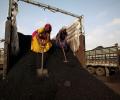
The growth of eight key infrastructure sectors rose to a 14-month high of 12.1 per cent in August 2023 against 4.2 per cent a year ago, mainly due to expansion in production of coal, crude oil, and natural gas, according to the official data released on Friday. The expansion in August is the highest since June 2022, when it was 13.2 per cent. The production of refinery products, steel, cement and electricity also grew in August, the data showed.

Pirojsha Godrej, 43, patriarch Adi Godrej's son, is set to take over as chairman of the Godrej Industries Group from 2026 whol Nyrika Holkar, Smita Godrej Crishna's 42-year-old daughter, has emerged as the face of the Godrej Enterprises Group.

The growth rate in the production of eight key sectors slowed down to a 20-month low of 0.1 per cent in October on account of contraction in the output of crude oil, natural gas, refinery products, and cement, according to the official data released on Wednesday. In October last year, these sectors expanded by 8.7 per cent. In September this year, the core sectors' output growth stood at 7.8 per cent.
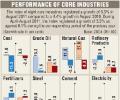
Eight infrastructure industries grew by 3.5 per cent in August this year, down from 4.4 per cent expansion witnessed in the same month last year.

Signalling both change and continuity, India's new government, headed by Prime Minister Narendra Modi for a third consecutive term, got into work gear on Tuesday with cabinet ministers and ministers of state filing into their respective offices to assume charge.

The core infrastructure industries had expanded by 5.2 per cent in the previous month.

RIL has proposed to charge the government- fixed rate for natural gas on a gross calorific value (GCV) basis, instead of net calorific value (NCV).

Dr Vijay Kelkar, adviser to the finance minister, will meet industry representatives on Monday in Mumbai to discuss his indirect tax proposals as well as pre-Budget issues.

During December 2011, the core sectors recorded a growth of 3.1 per cent against 6.3 per cent same period previous year.

Production of eight infrastructure sectors recorded an almost flat growth rate of 6 per cent in February as against 5.9 per cent in the same month last year, according to official data released on Friday. The growth in February is lowest in the last three months. The output of core sectors had increased by 8.9 per cent in January 2023 and 7 per cent in December 2022.
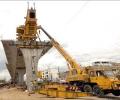
During April-August, the eight sectors grew by 4.4 per cent, against 4.2 per cent in the year-ago period.

The growth of eight key infrastructure sectors slowed down to 4.3 per cent in May 2023 due to a decline in the production of crude oil, natural gas and electricity, according to the data released by the government on Friday. The core sector growth was 19.3 per cent in May 2022, while in April 2023, the key infra sectors recorded a growth rate of 4.3 per cent. During April-May this fiscal, the output growth of these eight sectors slowed down to 4.3 per cent against 14.3 per cent in the year-ago period, the data showed.

The production growth of eight infrastructure sectors -- coal, crude oil, natural gas, refinery products, fertiliser, steel, cement and electricity -- was 19.3 per cent in May 2022, the data showed. In June, the output of coal, refinery products, fertiliser, cement and electricity rose by 31.1 per cent, 15.1 per cent, 8.2 per cent, 19.4 per cent, and 15.5 per cent, respectively.

If the Budget makes no big announcements on new schemes, projects, or tax giveaways, the government would face a major political dilemma as it may have to reluctantly consider shunning the practice of unveiling pre-election sops to woo voters, notes A K Bhattacharya.

'China is somewhat disappointing in its recovery, and slow growth, and India is reporting strong growth numbers.'

'We now look at divestment as an opportunity for maximising the value of public assets, not necessarily as a short-term resource-raising measure.'

Power sector accounts for 70% of total industrial water use; steel, paper also make it to the list.
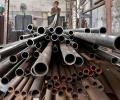
Growth of eight key infrastructure sectors slowed down to 8.2 per cent in June 2023 compared to the year-ago month due to a decline in the production of crude oil, according to the official data released on Monday.

Production of eight infrastructure sectors expanded by 3.8 per cent in December 2021 against a 0.4 per cent contraction in the same month last year on better show by coal, cement and refinery products, according to the official data released on Monday. Barring crude oil and steel, all sectors recorded positive growth in December 2021. The core sector industries had grown by 3.4 per cent in November 2021.

'The policy focus of the government should have been on creating more good quality jobs but that was not their focus.'

Barring crude oil and cement, all other sectors recorded positive growth in November. In October, these core sectors' output had grown by 8.4 per cent. In February this year, the growth rate contracted to 3.3 per cent.

Indian exporters are keeping their fingers crossed on account of rising Covid infections in China and other countries as it could again disrupt supply chains and affect demand for goods. Federation of Indian Export Organisations (FIEO) director general Ajay Sahai said that if the cases continue to increase in the coming days, it may have implications on imports. "We are keeping our fingers crossed," he said.

Minister of State for Commerce and Industry E M Sudarsana Natchiappan said the industry should reach out to people of those areas where they propose to set up projects and explain about the advantages locals can have in terms of employment and development.
The production growth of eight infrastructure sectors slowed down to 4.3 per cent in March due to a decline in the output of coal and crude oil, though for the full 2021-22 fiscal, the core sector recorded a 10.4 per cent expansion, according to official data released on Friday. The eight infrastructure sectors - coal, crude oil, natural gas, refinery products, fertiliser, steel, cement and electricity - had expanded by 6 per cent in February. During April-March 2021-22, the eight sectors grew by 10.4 per cent compared to a contraction of 6.4 per cent in 2020-21. The output of coal and crude oil contracted by 0.1 per cent and 3.4 per cent in March.
Operations of several top companies, located in central and south Gujarat, continued to be affected on Friday with torrential rains lashing several parts of Gujarat for close to a week.

The output of eight core sectors rose 4.4 per cent in September on account of healthy performance by segments like natural gas, refinery products and cement, official data showed on Friday. The eight infrastructure sectors of coal, crude oil, natural gas, refinery products, fertilisers, steel, cement and electricity had grown by 0.6 per cent in September 2020, as per the data released by the commerce and industry ministry.

E-auction or e-tendering moves the process of bidding for government contracts completely online, removing most manual procedures and, therefore, creating an accountability trail.

'I'm pitching India for the strengths we offer, including the English language, engineers, doctors, nurses, professionals, innovative talent of startups.'

If Modi wants to leave a real legacy, breaking India's strategic triangulation would be the real gift, notes Shekhar Gupta.

Overcoming its initial concerns, national reinsurer GIC Re has contributed to the formation of an insurance pool to cover most imports from Russia. While it will be called the fertiliser pool with a corpus of Rs 500 crore, it can be used to cover the risks of oil and gas imports too. This was decided by a clutch of Indian insurance companies, led by the state-owned ones. GIC Re's share is about 40 per cent in the pool. Last month, GIC Re had shot off a letter to all non-life insurance companies that underwrite marine risks not to ask it for reinsurance of cargoes that originate from Russia.
